




Beyond the Screen: Designing Tangible Interactions

A collaborative design workshop explores translating familiar digital media interactions into tactile, screenless objects that reimagine everyday audio-video experiences physically.
Students from the Master in Interaction Design and the Master in Product Design recently completed a three-session workshop in collaboration with Habits Design Studio, dedicated to transforming digital experiences into meaningful physical interactions.
The challenge invited participants to explore how specific functions from major audio and video platforms could be translated into small consumer electronic products—without relying on screens. Working with gestures, haptics, sensors, textural feedback and tangible interfaces, students set out to make selected digital behaviours physically perceptible.
Habits Design Studio is an award-winning strategic design and innovation studio renowned for its expertise in interaction design, product development and integrated digital–physical experiences. Founded in 2004, the studio collaborates with global brands to shape future-oriented products and systems that blend technology, aesthetics and human-centred thinking.
Following an introductory lecture delivered by Habits Design Studio, students were divided into groups and tasked with selecting a major audio or video platform. Each team worked on a speculative design concept aimed at reimagining one of the platform’s functions through a physical object—an exercise in envisioning hypothetical products that translate intangible interactions into tactile, engaging experiences.* Here below a selection of projects developed by Domus Academy Students:
Students explored Spotify’s core behaviours—memory, collaboration and shared music experiences—through three distinct physical concepts, each reinterpreting a key feature of the platform in tangible form.
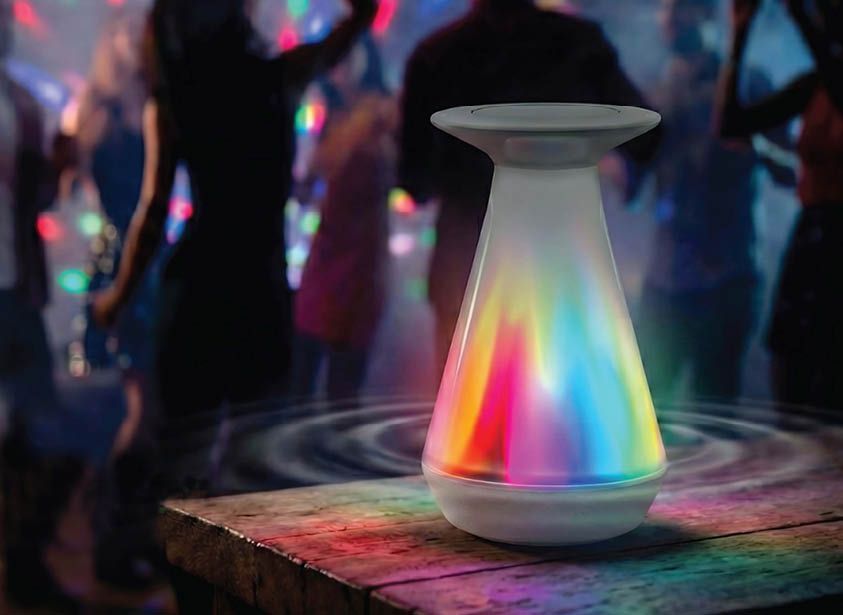
Spotify Party Speaker reimagines collaborative playlists as a shared physical experience. The Spotify Party Speaker introduces a gesture-driven interface enabling guests to co-create a unified party soundtrack. Activated through touch and equipped with an NFC zone for adding playlists, the conical speaker responds to a distinctive “shake-to-blend” gesture that merges everyone’s music preferences into an AI-generated flow of continuous, genre-balanced tracks.
The group introduced Prime Flow, a physical companion designed to make time, control and curiosity more intuitive while watching Prime Video. Shaped as a minimal circular object, it allows users to filter content by available time, check real-time progress or access X-Ray information through simple gestures such as touching, rotating or placing hands within the ring. By shifting key functions off the screen, the device maintains immersion and offers a calmer, more focused way to navigate and enjoy content.
The team developed GestureDock, a gesture-controlled stand designed to support hands-busy learning with YouTube. Combining wireless charging, a small camera and a secondary feedback screen, the device enables users to pause, scrub and capture screenshots through mid-air gestures—ideal for moments when hands are occupied in the kitchen, studio or workshop. By removing the need to touch the phone, GestureDock preserves creative flow and transforms YouTube tutorials into a seamless, embodied learning experience.
*All brands and digital platforms mentioned in this article—Spotify, HBO, Netflix, Prime Video and YouTube—are referenced strictly for academic and illustrative purposes.
The projects developed by the students are non-commercial, speculative explorations conducted within an educational workshop.
These brands did not participate in, endorse, sponsor or commission any of the concepts created.
Students independently selected the platforms as part of a design exercise aimed at envisioning hypothetical, unsolicited products that translate digital interactions into physical experiences.
FAQ – Frequent questions
1. What is the purpose of the “Beyond the Screen” workshop?
The goal was to identify digital platform features that could be transformed into tangible physical interactions, using gestures, haptics and sensors instead of screens.
2. What types of projects did the students create?
Students designed speculative physical concepts inspired by Spotify, Prime Video and YouTube, including gesture-controlled devices, tactile interfaces and off-screen content navigation tools.
3. What design programmes does Domus Academy offer in Interaction and Product Design?
Domus Academy offers a Bachelor of Arts in Design, a 2-Year Master of Arts in Design Innovation, and postgraduate programmes including the Master in Interaction Design and Master in Product Design, all focused on developing innovative digital–physical experiences.