




Philippe Starck and Domus Academy: designing beyond objects

From iconic everyday objects to spaces and experiences, Philippe Starck has challenged conventional ideas of design. His connection with Domus Academy reflects a shared culture of experimentation, curiosity and innovation.
Designer, architect, inventor and provocateur, Philippe Starck has helped redefine contemporary design by turning everyday objects, interiors and spaces into experiences.
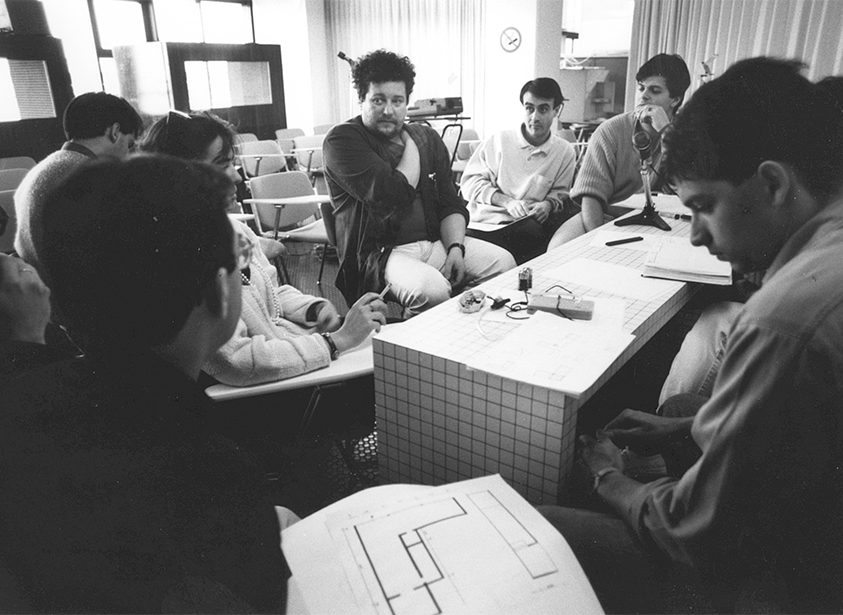
His connection with Domus Academy dates back to the school’s early years, in the Milan of the 1980s – an international laboratory for new ideas and new approaches to design.

PHILIPPE STARCK: RETHINKING THE EVERYDAY
Born in Paris in 1949, Philippe Starck is one of the most recognisable figures in contemporary design. The son of an aeronautical engineer, he grew up surrounded by technical drawings and prototypes, developing an early curiosity about how things work – and how they might be transformed.
From the 1980s onwards, his work gained international recognition, spanning product design, interiors, architecture and hospitality. More than a particular style, what connects Starck’s projects is a way of thinking: observing the world around us and asking whether it could be imagined differently.
This mindset has produced some of the most recognisable icons of international design. Juicy Salif, the citrus squeezer designed for Alessi, transforms an everyday kitchen tool into an almost sculptural object. With Louis Ghost, designed for Kartell, Starck reinterprets the classic Louis XV armchair through transparent polycarbonate.
Two very different objects, united by the same ability to make the familiar feel unexpected.
Behind the provocative character of many of Starck’s projects lies a clear belief: good design should not be reserved for the few. This is the principle behind democratic design: combining creativity with industrial production to make quality design accessible to a wider audience. Throughout his career, this idea has taken Starck far beyond the individual object. From furniture to hotels, interiors to architecture, design becomes a way to shape experiences, relationships and new ways of inhabiting spaces.
In other words, the true focus of design is not the object. It is the people who experience it.
The relationship between Philippe Starck and Domus Academy began at a particularly fertile moment for international design.
Founded in Milan in 1982, Domus Academy set out to create a new model for postgraduate education: not simply a school, but a meeting point for design, research, industry and experimentation. From its earliest years, the Academy brought together some of the most influential figures in design culture. Philippe Starck was among them, contributing as a lecturer and workshop leader alongside designers such as Ettore Sottsass, Alessandro Mendini and Denis Santachiara. His presence was a natural fit for the school’s experimental environment. Starck brought an approach that moved beyond conventional design categories, crossing disciplines, challenging established archetypes and starting with people rather than objects.
A common thread connects the experimental energy of the 1980s with the design culture of Domus Academy today: the idea that design is, first and foremost, a tool for exploration. The Academy’s learning by designing approach places the design process at the heart of education: experimenting, engaging with real-world scenarios, moving across disciplines and turning ideas into new possibilities.
This is also where Philippe Starck’s approach remains particularly relevant today. Not as a style to imitate, but as a mindset: to observe what already exists, question it and imagine what could exist instead. A lesson that remains central to anyone choosing to design for the future.
FAQ – Frequent questions
1. Who is Philippe Starck?
Philippe Starck is a French designer and architect known for challenging conventions across product design, interiors, architecture and hospitality.
2. What is Philippe Starck best known for?
He is known for iconic projects such as the Juicy Salif citrus squeezer for Alessi and the Louis Ghost chair for Kartell.
3. What is Philippe Starck’s idea of democratic design?
It is the belief that good, innovative design should be accessible to as many people as possible.
4. What is Philippe Starck’s connection with Domus Academy?
Starck was involved in the Academy’s early years as a lecturer and workshop leader, contributing to its experimental and interdisciplinary culture.
5. What connects Starck’s approach to Domus Academy today?
A shared view of design as a tool for exploration: questioning what exists, crossing disciplines and imagining new possibilities.