




Domus Academy: 45 Years Of Experimentation And Design Culture

The Origins: Milan and the birth of a Cultural Vision. From an experimental cultural project in 1982 to an internationally recognised design school, Domus Academy continues to shape the future of design.
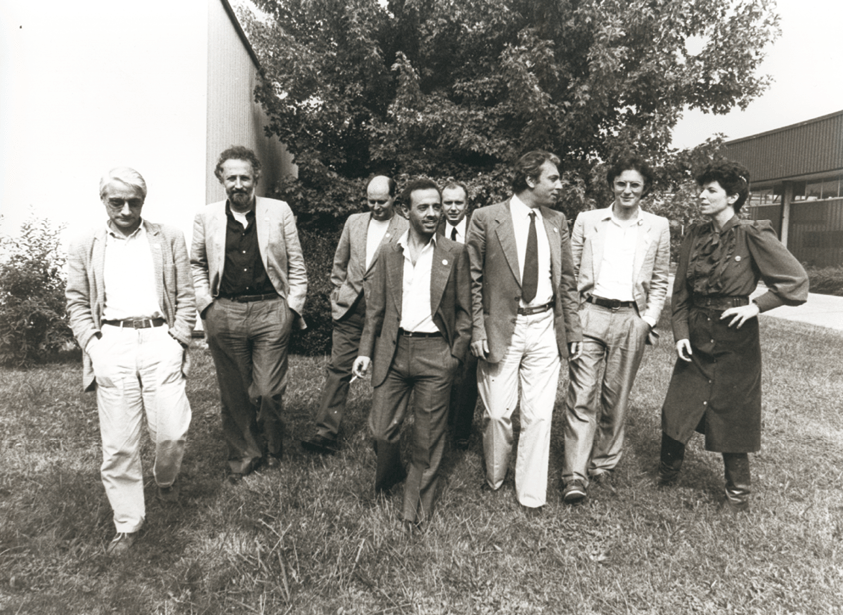
Domus Academy was founded in Milan in 1982 as a postgraduate school of design and fashion, at a time when Italian design had already earned international recognition, yet lacked a structured educational offering with a truly global outlook. Its founding brought together some of the most influential figures in Italy’s design and cultural landscape: Maria Grazia Mazzocchi, Alessandro Mendini, Alessandro Guerriero, Giulio and Valerio Castelli, alongside the contributions of leading intellectuals and designers such as Andrea Branzi, Ettore Sottsass, Gianfranco Ferré and Pierre Restany. From the outset, Domus Academy was conceived as more than an educational institution. It was a cultural project: a laboratory for ideas and experimentation, dedicated to reinterpreting and renewing the Italian design tradition in response to profound social, technological and industrial transformations taking place around the world.
Domus Academy’s roots lie in the creative and intellectual ferment that shaped Italian design throughout the 1960s and 1970s. Radical Design, the work of Archizoom, Superstudio, Alchimia and Memphis, as well as the experimental Global Tools initiative (1973–1975), challenged rationalism and the primacy of the product, advancing a vision of design as a critical, cultural and social practice. Domus Academy embraced and reinterpreted this legacy, while distinguishing itself from earlier movements and institutions such as the Bauhaus and the Ulm School of Design. Whereas these sought to establish a universal design language, Domus Academy set out to explore and convey the distinctive cultural, methodological and productive qualities of Italian design. Design thus became not simply a creative discipline, but a methodology for research and inquiry, capable of engaging with the complexities of contemporary life. Building on this vision, Domus Academy established itself as one of Italy’s first design schools with a genuinely international outlook, becoming a point of reference for design education worldwide.
From the beginning, Domus Academy challenged conventional academic models. Faculty and students worked together in a collaborative research environment, where design projects became the primary means of learning and educators acted as mentors rather than simply providers of knowledge. This approach encouraged interdisciplinarity and the exchange of ideas across different fields, establishing design as a transferable discipline extending beyond products and fashion to interiors, services, interfaces, strategies and the exploration of possible futures.
A defining feature of Domus Academy has always been its close relationship with industry. Through workshops, laboratories and experimental projects developed with Italian and international companies, the school has built a bridge between education, research and professional practice, enabling students to address real-world challenges while offering businesses opportunities to explore new perspectives. Alongside its educational activities, Domus Academy has developed a rich programme of exhibitions, seminars, publications and research initiatives. Its Research Centre, active since the 1980s, played an important role in developing the theory of primary design and advancing a human-centred approach that places people, relationships and experience at the heart of the design process.
Throughout its history, Domus Academy has continually evolved its educational offering, expanding from its original Master’s programmes in Industrial Design and Fashion Design to fields such as Interaction Design, Service Design, Urban Management, Business Design and Strategic Design. This evolution reflects the growing intersections between design, technology, sustainability, digital innovation and complex systems. Today, its international character remains one of its defining strengths: more than 90% of students come from outside Italy, and all programmes are taught in English. Through an extensive network of academic and institutional partnerships, Domus Academy continues to promote Italian design culture worldwide while strengthening Milan’s position as a global design capital.
Over the decades, Domus Academy has received numerous accolades reflecting its standing in international design education. In 1994, it was awarded the prestigious ADI Compasso d’Oro in recognition of its innovative cultural and educational vision. The school has also been featured in leading international rankings and publications covering design and fashion education, including the QS World University Rankings for Art & Design, as well as sustainability and social impact rankings such as UI GreenMetric. These achievements are complemented by the many international awards earned by its students and alumni.
An episode from the Academy’s earliest days, recounted by Antonio Petrillo, perhaps best captures the spirit behind its creation. At the very first meeting to establish Domus Academy, convened by Andrea Branzi, the discussion took an unexpected turn. Rather than focusing on curricula or courses, Branzi posed a provocative question to a group that included Ettore Sottsass, Mario Bellini and Clino Trini Castelli: Did it really make sense to establish a school of design and fashion in Milan, a city where design had traditionally been learned through hands-on experience in professional studios?
The answer was equally radical. Domus Academy would introduce an entirely new educational approach, built around three founding principles: to educate rather than simply instruct; to regard students as fellow researchers; and to establish the school for an initial period of just ten years, after which its continued existence would be reconsidered.
It was this final principle that made the idea truly revolutionary: a school should never take its existence for granted but must continually prove its relevance and necessity. As Petrillo recalls, the statement transformed the atmosphere in the room. A profound, almost solemn silence fell over the participants, who realised they were embarking on something far greater than an educational venture: they were taking on a genuine cultural and historical responsibility. Originally conceived as an experiment whose purpose would be reassessed after a decade, Domus Academy is now approaching its 45th anniversary, continuing to redefine its role in design culture.
Perhaps this is its most enduring legacy: never treating its educational model as definitive, but making the willingness to question, challenge and reinvent itself the very reason for its existence.
FAQs - Frequently asked questions
When and where was Domus Academy founded?
Domus Academy was founded in Milan in 1982 as a postgraduate school of design and fashion.
What was the founding vision of Domus Academy?
To approach design as a tool for research, experimentation and cultural innovation, beyond traditional disciplinary boundaries.
What makes Domus Academy's teaching approach innovative?
An interdisciplinary, experimental approach built on collaboration between students, faculty and industry through real-world projects.
Why was Domus Academy originally meant to last only ten years?
It began as a ten-year educational experiment, reflecting the belief that a school must continually prove its relevance.
What is Domus Academy's legacy after 45 years?
A design culture rooted in research, experimentation and reinvention, contributing to the evolution of Italian design.